For most WVARC members, NY7S is the familiar voice of the Del Webb repeater. Behind that signal is a compact communications facility connecting radios, computers, controllers, network equipment, and antennas high above Sun City West.
Story and photos by Eric Howell, KM7GHS.
A look inside NY7S
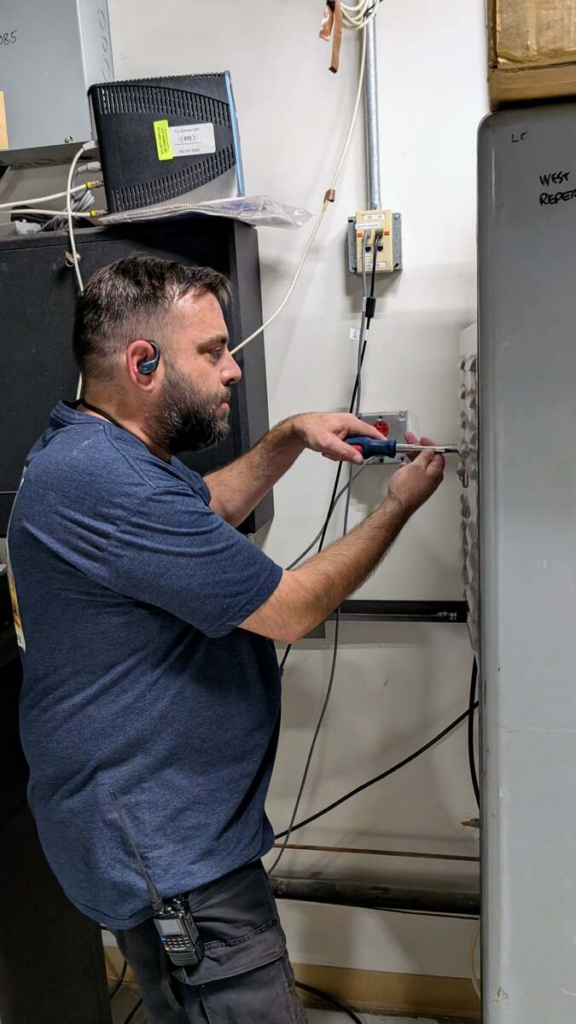
On July 25, 2026, Josh Cavender, KE7WIL, invited me to visit the West Valley Amateur Radio Club’s NY7S repeater site at Banner Del E. Webb Medical Center. A member of the hospital maintenance staff escorted us to the fourth-floor elevator machine room, where the repeater equipment and roof access are located.
After nearly 30 years in broadcast video engineering, I have spent a lot of time around equipment racks. I expected to find a repeater, a controller, and perhaps a small computer supporting the AllStar node. Instead, NY7S turned out to be a small communications facility packed into a six-foot rack.
More than a repeater
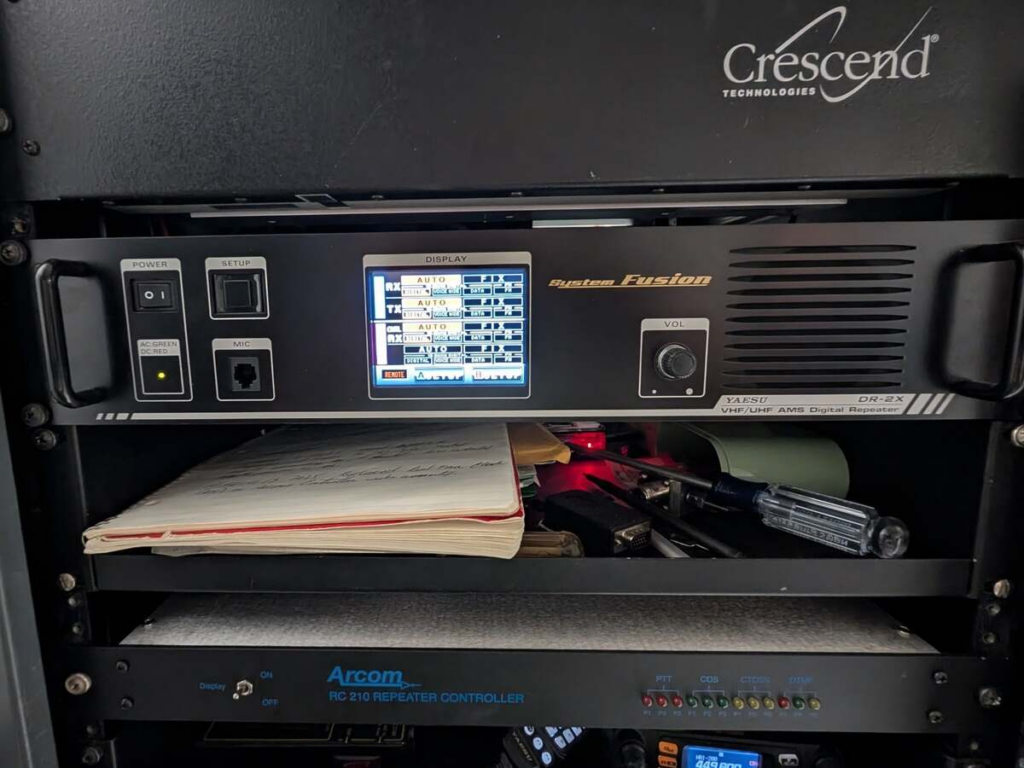
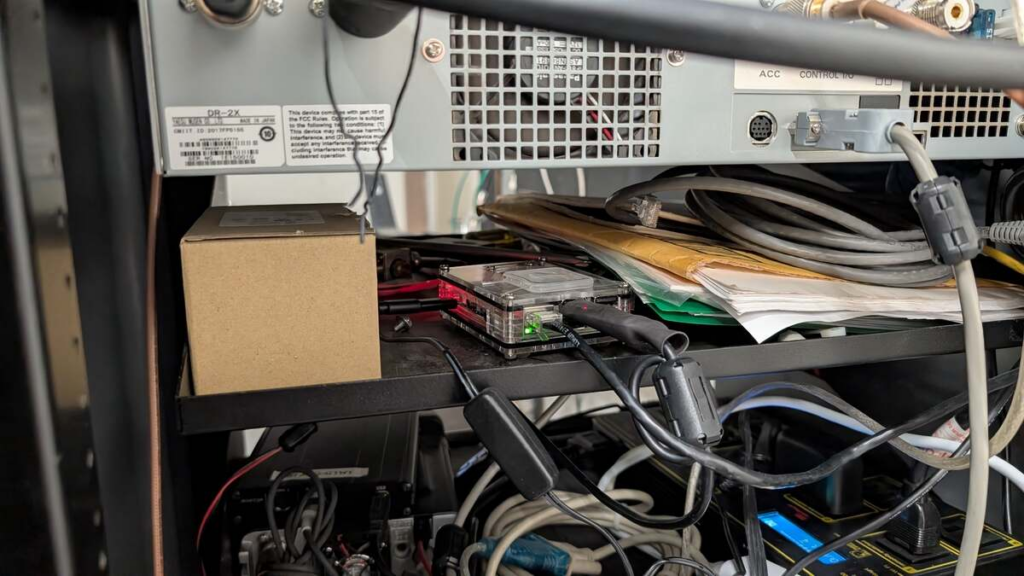
The NY7S rack contains the primary repeater, its controller, supporting RF hardware, computers, network equipment, power supplies, the AllStar node, and the equipment that connects the W7JHQ repeater at Boswell Medical Center to WIRES-X.
What first appears to be one repeater is really a collection of radio, computer, control, and network systems working together. Nearly every part of the rack has a job.
Repeater snapshot
NY7S — Del Webb
147.300 MHz (+600 kHz) · PL 162.2 Hz · FM
AllStar node 63916 · EchoLink 598882 / NY7S-R
W7JHQ — Boswell
449.800 MHz (−5 MHz) · PL 100.0 Hz · Fusion/FM
WIRES-X room 81854
Connecting Del Webb and Boswell
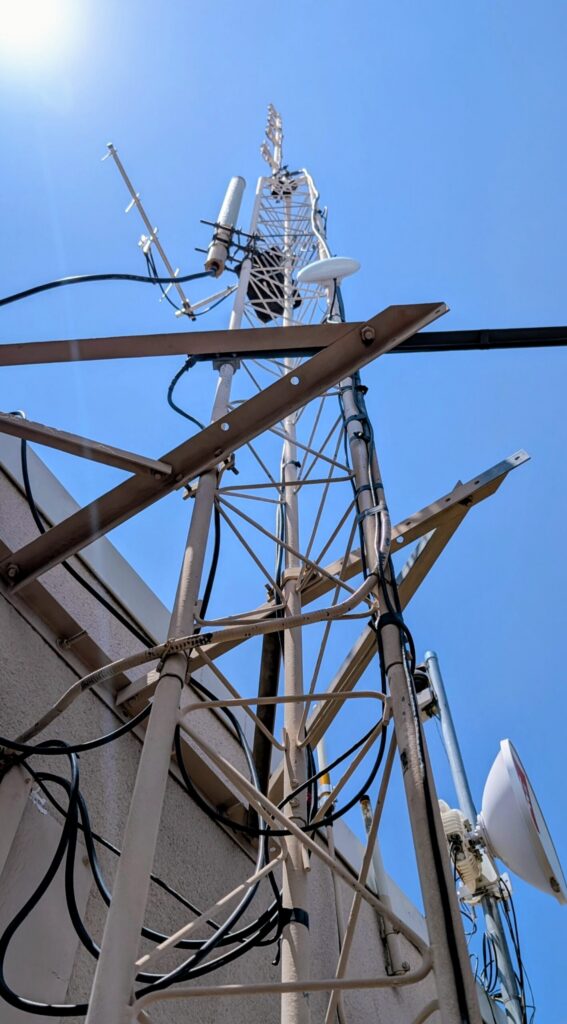
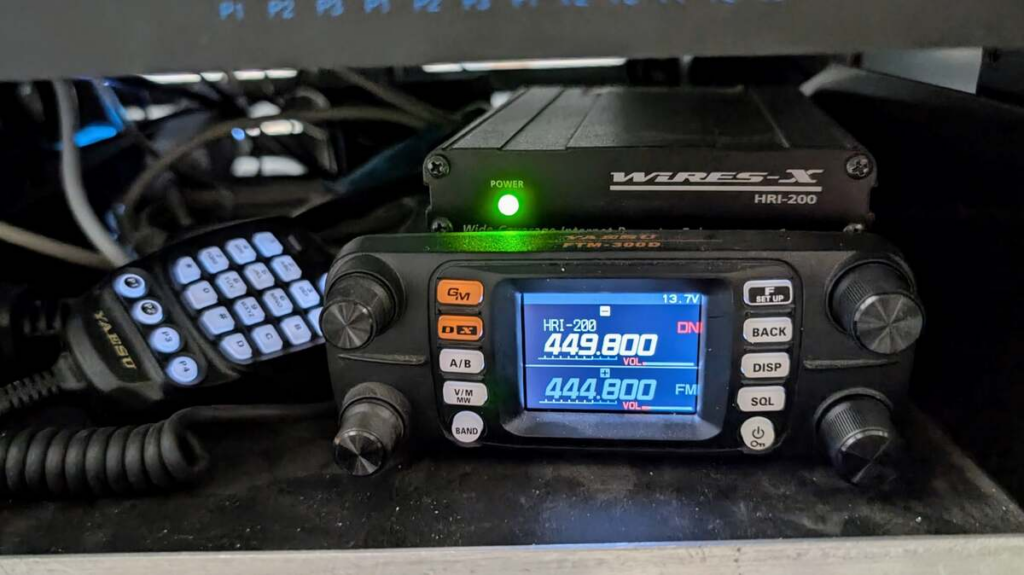
The Del Webb site also supports the W7JHQ System Fusion repeater at Boswell Medical Center. A UHF antenna on the NY7S mast provides the radio bridge between the two locations. At the Del Webb end, a Yaesu FTM-300D and HRI-200 connect that link to WIRES-X.
The site’s Internet connection also arrives by radio. A Ubiquiti wireless bridge on the NY7S mast links the hospital site to KC0UU’s ham shack. That connection supports the networked services used by AllStar, WIRES-X, and the site’s control equipment.
The cavity duplexers
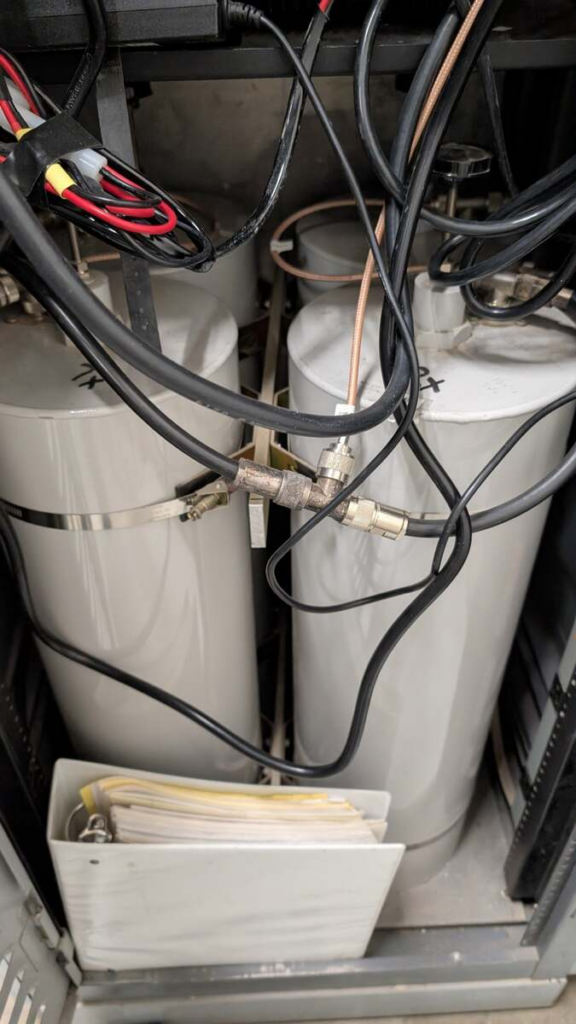
One of the largest parts of the installation is easy to overlook: the cavity duplexers. A repeater must receive a weak signal while transmitting a much stronger signal only 600 kHz away. Without enough isolation, its own transmitter would overwhelm the receiver every time the system keyed up.
The tuned cavities separate the transmit and receive paths while allowing both frequencies to share the same antenna. They are physically large, but that size is part of what makes the filtering possible at VHF.
The equipment behind the signal
Daily nets and routine conversations make the Del Webb repeater feel simple: key the microphone, wait for the courtesy tone, and talk. The site visit showed how much equipment and coordination operate quietly behind that familiar signal.
NY7S is more than a radio mounted in a hospital. It is a continuously operating club communications site linking local operators, Internet-connected networks, and the W7JHQ repeater at Boswell. Seeing it firsthand provided a much better appreciation for the systems—and the club members—that keep it on the air.